I’ve resigned from the Evidence for Democracy (E4D) Board of Directors. It was a difficult choice and I’ll miss it.
I continue to be an enthusiastic supporter of E4D and I’m excited to see it grow its impact. There is significant room to grow science and science advocacy in Canada. E4D plays a unique role in making that case and helping turn it into action. I hope you, too, will consider following and supporting them.
It has been a privilege to be part of E4D’s journey from its early days as a small start up NGO to a nationally recognized organization. I remember the Stand Up for Science rallies in 2013 fondly. That was over 12 years ago. I’m proud of where it is today.
Once I passed the ten year milestone, I began thinking it was time to step down. I’ve been involved for nearly 13 years at this point. Change in leadership, perspective, and energy is important. E4D has recruited fantastic new board members and staff ready to carry its mission forward. I’ll be cheering for them.
Aside from believing sincerely in its mission, one of the biggest reasons I stayed involved with E4D so long is the people. I enjoy thinking alongside the board, staff, and supporters about Canada’s support for science, the connections between science and society, and the links between evidence, transparency, and a well-functioning democracy. I feel very fortunate to have met so many smart, insightful, and inspiring people connected to E4D at all levels.
I’m not sure what my next outlet will be for my science and education interests (outside my regular job). The short term will involve a break. But in the medium term I expect to be keen to contribute somewhere. Suggestions are welcome!
Photos: March for Science kick off rally in Toronto, 2017. Credit: Paul Martin
I’ve been asked many times by friends, audience members at public talks, and journalists:
“Why is PEARL needed now that Canada has CHARS?”
The question came up again recently because of discussion about the Trudeau government’s decision not to renew or replace the Climate Change and Atmospheric Research (CCAR) program, which had funded a range of research projects – including PEARL. This is the latest development in a long string of cuts to Canadian climate science. Top scientists in the field have described the current funding situation as a “crisis”.
Both the Harper and Trudeau governments have pointed to CHARS as a reason to commend their efforts in the areas of Arctic and climate research. I support CHARS. It’s a world-class facility that will contribute great science. But CHARS doesn’t accomplish what PEARL or the CCAR program does. In this post, I’ll highlight some of the major differences.
First, I will briefly describe what each of those acronyms refer to. Both PEARL and CHARS are permanent research stations in the Canadian Arctic. But they are quite different entities.
CHARS is the Canadian High Arctic Research Station, a new $204 million federal government facility with an annual budget of $26.5 million. Its focus is on ecology, sustainability, and northern communities. Located in Cambridge Bay, Nunavut, CHARS is part of Polar Knowledge Canada (POLAR), an agency of Crown-Indigenous Relations and Northern Affairs. POLAR’s headquarters is located in the main CHARS building.
The Canadian High Arctic Research Station (CHARS). Photo credit: Government of Canada / CIRNA flickr account (here).
PEARL is the Polar Environment Atmospheric Research Laboratory, an atmospheric observatory located near Eureka, Nunavut on Ellesmere Island. Originally built as the Arctic Stratospheric Ozone Observatory (AStrO) in 1992 by Environment Canada, it re-opened in July 2006 as PEARL under the leadership of Canadian university scientists (full time AStrO operations ended in 2001 due to budget cuts). Over the last decade, its capabilities have grown significantly. It is now one of the world’s most comprehensive and sophisticated atmospheric observatories in the Arctic. At 80°N, it is the northernmost site for many types of ground-based atmospheric observations. PEARL has a budget of approximately $1 to 1.5 million/year.
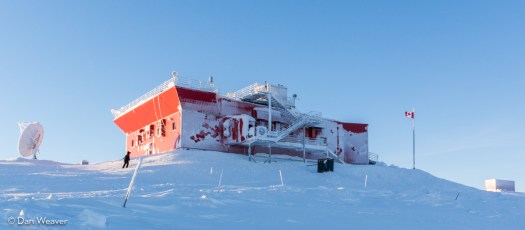
PEARL Ridge Lab
Immediately it’s clear there are big differences. CHARS is a major government facility with a broad mandate; PEARL is a remote academic-run atmospheric observatory.
I’ll add a few details about the key differences: location, science, and scale.
The location.
The Canadian Arctic is huge. While both PEARL and CHARS are in Nunavut, PEARL is 1200 km north of CHARS. That’s roughly the distance between Toronto and Halifax or between Calgary and Yellowknife.
Map showing location of CHARS & Cambridge Bay and Eureka & PEARL
Cambridge Bay is a community of 1800 people and has regular commercial flights from Yellowknife.
On the other hand, Eureka is a remote research outpost that cannot be reached by commercial flights. When PEARL researchers travel to the facility for fieldwork, they take small charter plane from Yellowknife, stopping in Cambridge Bay and Resolute on their way north to Eureka to refuel.
Their different locations reflect their different scientific priorities.
The Cambridge Bay location is good for biologists and ecologists because it is close to many different ecosystems as well as caribou and muskox populations of interest to biologists. It also has a central Arctic location, which will help it to support field work in the surrounding region.
Map illustrating the many different ecoregions near CHARS and Cambridge Bay (from talk slides by CHARS Chief Scientist Dr. Raillard here)
While there would be value in doing atmospheric measurements at CHARS, Cambridge Bay isn’t an ideal place to do all the research done at PEARL. For example, the location is too far south for it to be within the Polar Vortex regularly during the February/March window when sunlight returns and ozone depletion chemistry occurs. AStrO/PEARL was built in Eureka because scientists needed measurements that far north.
Location of the Polar Vortex, PEARL, and CHARS (January 2018). Image source: earth.nullschool.net
Cambridge Bay can’t offer the same ability to do satellite validation, either. Eureka is a sweet-spot, where many Canadian and international satellites frequently pass overhead due to their orbital geometry.
Available satellite overpasses at Canadian Arctic sites for a common orbit (Fogal et al. 2013)
Lastly, the environment is simply different at CHARS than at PEARL. As noted, they are quite distant from one another. If you want to measure the atmosphere of the high Arctic, you have to go there.
The type of science they do.
CHARS’s original priorities were resource development, science, and the development and commercialization of technology. When the Trudeau government came into power, they shifted that mandate away from resource development and technology commercialization and towards northern communities and sustainability.
The physical lab space of CHARS was designed with biology in mind. For example, there is a large animal necropsy facility (complete with a crane for loading large animals), genomics lab, as well as a cold lab for studying ice cores and a growth chamber for studying plant growth. (The CHARS floor plan is online here.) Indeed the CHARS Chief Scientist, Dr. Martin Raillard, is formerly a field scientist for Parks Canada and the Canadian Wildlife Service. His expertise aligns very well with the station’s priorities.
CHARS floor plan (ground floor)
There are no rooftop labs at CHARS. Skyward-looking science was not part of the CHARS design. There are no astronomy or atmospheric instruments, for example. The promotion of CHARS in the media and elsewhere often describe it as a facility for “Arctic science”. I think this is why I keep getting asked about CHARS: people get the mistaken impression that it is able to do everything involving science in the Arctic.
View of the CHARS facility. Photo credit: Government of Canada. Source here.
I’m certain there are atmospheric scientists keen to potentially set up instruments at CHARS. It could be a useful addition to existing networks. But CHARS would have to have an interest in doing so, and such a collaboration wouldn’t replace other observation sites like PEARL.
Roof of the PEARL Ridge Lab: where the action is
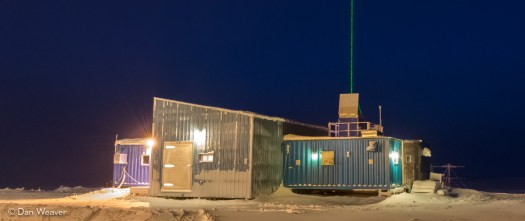
PEARL doesn’t have facilities for biology or ice core analysis. But it does have world-class instruments that measure the high Arctic atmosphere and that contributes to studies of atmospheric chemistry, climate, aerosols, and many other related topics. None of these measurements are done at CHARS.
PEARL 0PAL lab (with LIDAR operating)
Scale
CHARS is a larger operation than PEARL. The annual budget for CHARS operations is $26.5 million. There is over 50 staff. The site has space for dozens of scientists, including housing for about 50. There is also a large public space inside and outside the main building aimed at fostering connections with the surrounding community. Science done through CHARS involves fieldwork across the territories, not only the Cambridge Bay site.
Nunatsiaq News reports that the government spent $1 million on artwork that was installed outside the main CHARS building (the “Polar Iconic Structure” by Wei Yew). I fully support public art. It looks really great. But its cost illustrates the different the scale of these two facilities. The money spent on that art installation could fund PEARL for a year.
PEARL, when fully funded, operates on a budget of about $1.5 million. The current Minister of Science, Kirsty Duncan, once called the amount needed to operate PEARL “a pittance” for what it accomplishes. (Indeed, she recently helped arrange temporary support to prevent PEARL from closing due to budget cuts to Canadian climate and atmospheric science funding.)
PEARL has one major scale advantage over CHARS: some of its key datasets go back 25 years. These long-term measurements are extremely valuable for scientists looking at how the atmosphere and climate are changing over time. CHARS will build up datasets over time, but for the moment, they’re still in year one.
Polar Iconic Structure by Wei Yew. Photo credit: Government of Canada / CIRNA flickr account (here)
PEARL has an extensive suite of instruments spread across multiple locations near Eureka. Often, only one or two technicians are on site. Researchers at Canadian universities connect to instruments remotely through the world’s most northern geostationary satellite internet link.
PEARL technician cleans wind instruments at the flux tower
For a few weeks at a time, campaign teams of 2 to 10 researchers conduct more intensive operations on site at PEARL. Although the PEARL Ridge Lab has two rooms with bunk beds, PEARL researchers typically sleep and eat at the nearby Eureka Weather Station.
Summary
POLAR/CHARS could decide to expand its activity to include atmospheric measurements. That could be beneficial for both CHARS and the Canadian atmospheric and climate community. What is far less clear is whether POLAR/CHARS could expand to become a source for funding the type of research formerly supported by CCAR and other lost programs. Since PEARL offers capabilities CHARS lacks, it could be a complementary match. But this would not be an easy fit, given the differences in structure and priorities. NSERC, the organization that funds physical sciences in Canada, recommended renewal of CCAR.
There are many fields of science that contribute to understanding the vast Canadian Arctic. CHARS is a huge investment in northern science that should be celebrated. But we also have to recognize what it doesn’t accomplish, and the value of other research projects going on across the region as well. At the moment, there is a significant gap in Canadian climate science funding left by the Trudeau government’s cancellation of CCAR. CHARS doesn’t fill it. At least, not in its current form. In my view, Canadian science is best served by supporting both CHARS and PEARL as separate entities that each contribute important research in the Canadian Arctic.
Fogal, P., LeBlanc, L. M., and Drummond, J.R.: The Polar Environment Atmospheric Research Laboratory (PEARL): Sounding the Atmosphere at 80 North. Arctic, 66 (3), 2013. Stable URL: http://www.jstor.org/stable/23594645
Yesterday, the government announced it will support science and operations at PEARL, Canada’s high Arctic atmospheric research facility, until fall 2019. That is great news.
Canadians and scientists spoke out. Politicians responded. Science advocacy works.
What’s next? Is this ‘mission accomplished’?
No. Not at all. This is only a first step.
The announced support is “bridge funding,” meaning that it is temporary and short-term. It solves an immediate problem: PEARL was preparing to shut down due to a rapidly approaching end-of-funding horizon in a few months. Many long-term datasets and projects studying how the atmosphere works and how it is changing were at risk. This new funding ensures those measurements will continue. For a while.
What’s on the other end of the bridge?
At the moment, nothing. We’re poised for another funding crisis in 2019. Just like 2017. And 2012. And 2002*. Will I find myself leading another march for science, asking the government to fund PEARL again in a couple years? (I discussed this in a recent Story Collider event: script here.)
This temporary funding for PEARL is necessary because the Trudeau government decided not to continue or replace the existing formal funding mechanism, the Canadian Climate and Atmospheric Research (CCAR) program. CCAR supported several major research projects, one of which was PEARL. CCAR was evaluated by NSERC a year ago (online report & infographic), which recommended continued funding because it provided unique and much-needed support for Canadian scientists. It even noted PEARL wouldn’t exist without CCAR – it “saved PEARL” in 2013. But no money was allocated to continue CCAR in the spring budget, creating a crisis in Canadian climate science funding. Other affected projects are still without a clear path forward.
“Climate change research and the Arctic are far too important and they deserve more than one-off efforts. They deserve a comprehensive, thoughtful, approach.”
She is absolutely right. But what we have at the moment is another one-off effort. What we need next is the comprehensive, thoughtful approach.
CCAR wasn’t perfect. It only had one scale of project funding and was designed to accept proposals only once every five years. The funds had limitations, e.g. PEARL couldn’t pay for electricity using CCAR grant money. And clearly the CCAR structure wasn’t immune from political winds. It existed briefly, to pick up the pieces after an earlier, larger funding program was left to crumble by the Harper government, only to be ended by the Trudeau government. This hardly seems to have been a stable, long-term platform for supporting climate science.
Canada can do better.
We could create a foundation to administer climate and atmospheric research funding. It could be set up at arms-length from the government with an eye on the long-term nature of the issues. It should offer support for research at multiple scales, and have regular calls for new proposals. This was done before, in the early 2000s. It was called the Canadian Foundation for Climate and Atmospheric Sciences (CFCAS), and was ended in 2011 by the Harper government. This precipitated PEARL’s 2012 funding crisis.
CFCAS was a good model that could be used as inspiration for this government’s own solution. Its annual reports are still available online, and outline the enormous impact it had in ensuring that Canada was a leader in atmospheric and climate science – exactly the outcome yesterday’s press release identifies as the big picture goal.
Emergency last-minute funding squeezed out of somewhere is not the way Canada should support important science. We need stable, long-term funding for climate and atmospheric research, guided by a vision for Canadian science and environmental stewardship.
Our next step, as scientists, citizens, and science advocates, should be to push Canada to create a plan to secure Canadian climate and atmospheric science expertise and leadership for the long-term.
* The PEARL Ridge Lab was originally constructed in 1992 by Environment Canada to monitor stratospheric ozone depletion under the name Arctic Stratospheric Observatory, or AStrO. Due to cuts to research funding, AStrO closed in 2002. See, for example, EC’s old webpage on AStrO. It took a few years for Canadian academics to re-open the facility as PEARL. It was significantly expanded under the leadership of Prof. Jim Drummond.
Dan Weaver at the 80 degree north sign between Eureka, NU and the PEARL Ridge Lab.
A month ago I was a story teller at a Science Literacy Week event in Toronto called Story Collider. My story was about the excitement of travelling to the high Arctic for fieldwork the first time, only to find out during the first week that the government was cutting its funding. This prompted me down a path of science advocacy. This script aims to share some of my feelings on the experiences.
Story Collider was different from the other public speaking I’ve done. There was no one else on stage. There was nothing else on stage – no slides, no notes. Just me and a mic. The simplicity of this arrangement helped create a personal connection with the audience.
(Nice blog entry by science writer Mirjam Guesgen summarizing the event here.)
In this post I’ve added a few photos to illustrate what was in my head at the time. At some point, the audio recording of the event will be released and I’ll add a link.
Here we go…
Dan Weaver telling his story of fieldwork and science advocacy at Story Collider in Toronto (photo credit: Ally Chadwick, @JustMyFreckles)
Flying across the Canadian Arctic is an exhilarating experience.
It’s a full day’s journey. Canada’s Arctic is huge. The landscapes are stunning; there are mountains and fjords, waterways and sea ice (for the moment anyway).
View from the plane to Eureka
I do the trip when it’s the end of Polar Night, when light is returning after months of continuous darkness. In a small charter plane, the ride is loud and bumpy. There is no bathroom. With lots of scientific equipment along for the ride and everyone wearing massive parkas, space is limited. Every pound of weight is planned and verified. Weather can be difficult.
Inside the plane to Eureka (photo credit: Dan Weaver)
I remember the time the landing gear wheels got stuck – likely due to ice – and the landing in Resolute Bay (along the northwestern passages) was… abrupt. Another time, there were high winds. I remember trying to enjoy the landscape growing ever-closer out the window as the plane approached a runway at a steep angle – only levelling out at the last minute. It was a relief to land.
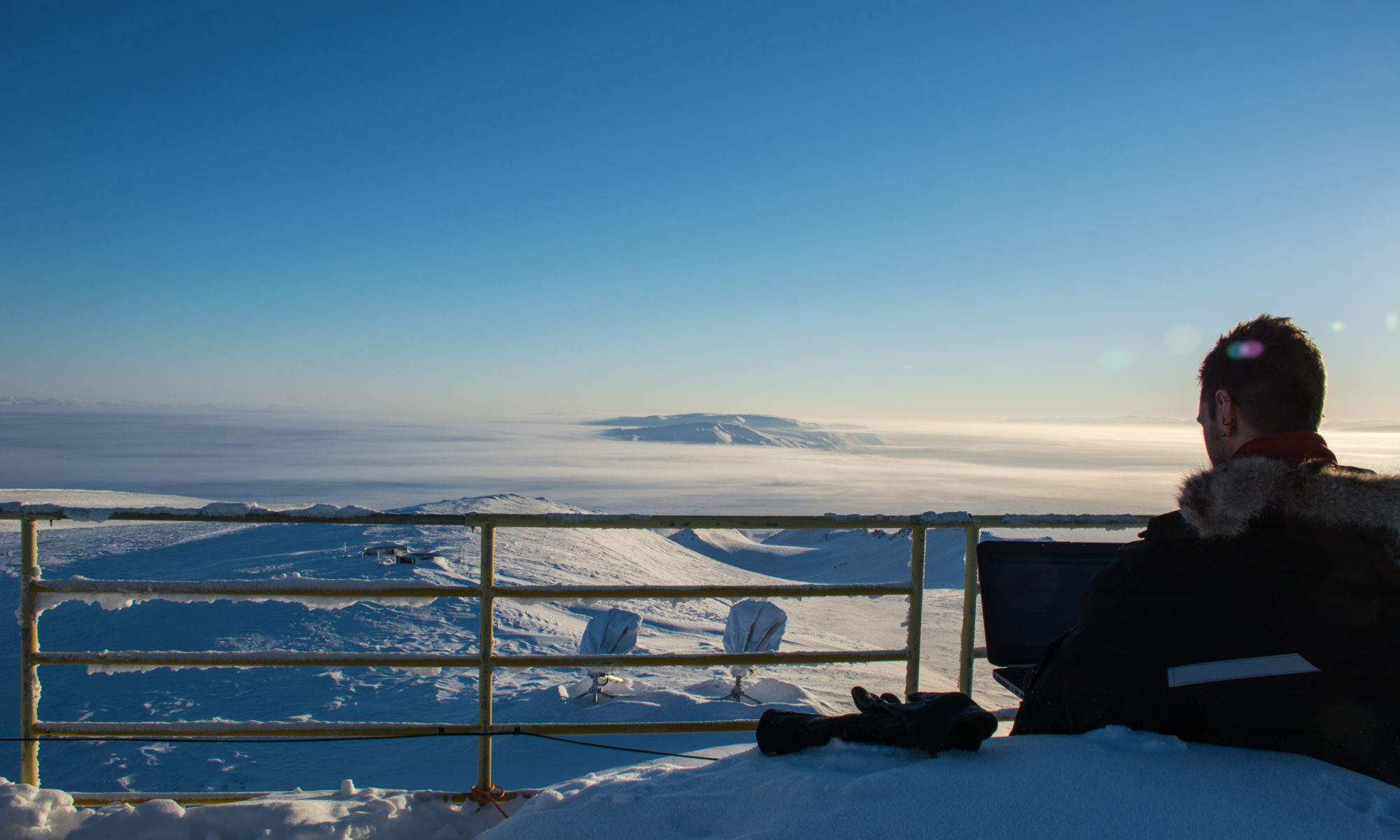
The effort is worth it. When I finally arrive in the middle of Ellesmere Island’s polar desert, it takes a half hour drive, down a desolate Arctic dirt road, to reach the Polar Environment Atmospheric Research Laboratory, or PEARL.
Remote Arctic road to the PEARL Ridge Lab (photo credit: Dan Weaver)
It’s further north than the northern lights, Inuit, and all Canadian settlements except the Alert military base. I have done the journey many times to do fieldwork.
Where is PEARL (Dan Weaver/Google Maps)
I’m an atmospheric physicist.
When everything is working well, I love going for hikes around the lab. Our parkas and snow pants mostly protect us from temperatures as low as -50ºC, but after a while your eyelashes end up freezing together. (The important thing is not to pull the ice off – melt it gently with your hands.)
Dan after a nighttime hike near Eureka (photo credit: Dan Weaver/Paul Loewen)
If you can keep your eyelashes from freezing, it’s also awesome to see the wildlife. Arctic bunnies and foxes. (A few more photos here.) But sometimes, cables get chewed by curious Arctic wolves. So that’s a challenge, too.
Arctic Hare near PEARL (photo credit: Dan Weaver)
Whether you’re a grad student or tenured professor, you’ll find yourself shovelling snow when the truck gets stuck in a snowdrift. I’ve shovelled snow next to the best in my field.
Shovelling snow between Eureka and the PEARL Ridge Lab (photo credit: Dan Weaver)
Without PEARL, scientists would have a big question mark across a significant part of the Arctic.
PEARL Ridge Lab (photo credit: Dan Weaver)
When I first joined the team, I was proud to be part of big, planet-wide endeavours aimed at understanding our changing world.
Installing instruments on the roof of the PEARL Ridge Lab at the start of the campaign (photo credit: Dan Weaver)
My first week at PEARL, in February 2012, was a whirlwind of activity. The cold was extreme, but I was thrilled. Maybe even moreso because of it. (I mean, I grew up in Ottawa, so I was ready for the Arctic, right??)
The Polar Vortex was overhead. The sawtooth mountain range carved out a jagged horizon to the east. A Canadian satellite mission flew overhead regularly; working in combination with PEARL instruments to observe the changing atmosphere. When I first arrived, the sun didn’t rise until 11 a.m. With each day, it rose a little bit earlier. After a month of being there, the sun set late into the evening.
Distant sawtooth mountains, viewed from the roof of the PEARL Ridge Lab (photo credit: Dan Weaver)
sunset from the PEARL Ridge Lab (photo credit: Dan Weaver)
….. But there was darkness on the horizon ….
A photo I’d taken of the lab and surrounding landscape during one of my very first days on the campaign made the front page of a major newspaper. I was excited but also heartbroken. The story was not about the tremendous science we were doing, but that it was all coming to an unexpected and sudden end. The government had decided to end funding for atmospheric and climate research. We would finish the campaign, and then the lab would be left in hibernation.
Le Devoir’s coverage of the 2012 PEARL funding crisis
A few weeks later, the last day of the campaign arrived. I made the most of it and enjoyed the view from the PEARL roof. I didn’t know if I’d ever return.
View from the PEARL Ridge Lab of Slidre Fiord (photo credit: Dan Weaver)
When I got back to Toronto, I realized PEARL’s closure was one story within a much larger one. Canada seemed to be dismantling its research capacity, with environmental work taking the biggest hit. The Experimental Lakes Area was closing, the census was cancelled, science libraries were being shut. Scientists in the federal government were fired by the thousands and those remaining were muzzled.
My perspective on the situation expanded beyond the PEARL facility, beyond the Arctic, and beyond science. Into politics. I started a #SavePEARL campaign.
Hmmm, I didn’t expect to get involved in politics when I decided to do a physics Ph.D… it’s not what I signed up for, but it was what was needed.
I wanted Canadians to understand what was being lost, and why it was important. I wanted there to be a public outcry to Save PEARL, and to save Canadian science.
Fast-forward a few years
I find myself marching down the streets of downtown Toronto, with a lab coat on and bullhorn in my hand. Hundreds of people march behind me.
I’m feeling exhilarated again. This time, not for doing science, but for rallying people to support it politically. Today, it still amazes me this was necessary at all.
I joined Canada’s leading group of science activists, who’d formed a new organization called Evidence for Democracy to advocate for science. There were marches and protests across Canada, calling on the government to fund science. It was a scene that would be repeated again on a global scale with the March for Science, which I also helped lead with a lab coat on and a bullhorn in my hand. This time, there are thousands of people behind me.
Dan kicks off the Toronto March for Science (photo credit: Paul Martin)
I learned that when Canadians speak loudly enough, politicians listen.
PEARL was eventually saved by new funding. There was a big gap in valuable long-term datasets that could never be recovered – the damage was done, but at least the work could begin again.
Walking to the PEARL Ridge Lab (photo credit: Dan Weaver)
I returned to PEARL each winter for fieldwork, and operated instruments remotely during the rest of the year. I upgraded instrumentation, tested new measurement techniques, and have been using PEARL measurements to validate new satellite data. Busy filling in those question marks with data.
Dan adjusting beamsplitter door of the PEARL 125HR spectrometer (photo credit: Dan Weaver / Paul Loewen)
When the 2015 federal election arrived, I was pleased to see the winning party had lots of promises on science. I thought this time would be different. My years of campaigning for science were finally paying off.
Maybe Canadian research would be on firmer footing now.
Today, I’ve got what I need: cool photos, amazing memories, and a soon-to-be-finished Ph.D. But I know Canada still needs PEARL, if we’re to understand the Arctic and our atmosphere. Our international partners still need PEARL, so we can together fill in those many question marks about how our world is changing.
Dan meets Trudeau in Iqaluit and discusses need for long-term science funding. I tried!
I expected the new government would expand funding for atmospheric and climate science, but it didn’t. The only program supporting this type of work was ended. There have been no promises of funding in the future. I asked Trudeau himself when we, quite by chance, were both in Iqaluit several months ago. He said he’d talk to the Minister of Science. Nothing came of it.
How many times will I have to put on a labcoat, and instead of walking into a lab, walk into the street to march for science?
Science only happens when we decide to support it.
Will you?
** Update: temporary short-term ‘bridge’ funding has been announced that ensure PEARL won’t close immediately. (CBC North story.). But it isn’t a long-term solution. It simply kicks the can down the road. (My thoughts here.) This script is as relevant as ever. Will I march for science again in 2019 to call on the government to fund PEARL? I hope it won’t be necessary.