Baseball throw from the CN Tower — fun physics

The question

A Sportsnet reporter, Shawn McKenzie, recently asked a question that’s surprisingly tricky to answer:

could someone standing on the CN Tower throw a baseball all the way to third base at the SkyDome? 

From the CN Tower’s observation deck or EdgeWalk the baseball field looks close. Close enough to be a tempting target for a baseball throw…

Sportsnet turned the question into a great 5-minute video you can watch on YouTube:

(It’s also on Instagram here: https://www.instagram.com/p/DPRkyJ_EaRE/?igsh=Z2JuMXB5YzJhcWc1)

They included a short clip from what was a 30+ minute interview. We had a great conversation. For anyone interested, I thought I’d post more details about the physics of this scenario. 

(Personal aside: I worked as a host at the CN Tower during my undergrad degree. Hosts are the people who help visitors everywhere around the site – including the elevators rides. I enjoyed it. I recall looking down at the baseball field when the dome was open. However, it was also part of my job to ensure people didn’t throw objects from the lower observation deck, which used to be open to the air with a metal mesh…) 

Set up: the key information we need

To do this calculation, a few key facts need to be clarified: 

  • Characteristics of a baseball, 
  • Height, i.e., where the person is positioned at the CN Tower, 
  • Target distance, i.e., from the CN Tower to SkyDome’s third base, and
  • Speed of the throw, e.g., by a regular person and by a professional.

With this information we can estimate an answer.

A baseball’s physical characteristics are described by Major League Baseball official documentation here (section 3.01):

  • Mass: 5 to 5.25 ounces, which I converted to 145 grams
  • Circumference: 9 to 9.25 inches, which I converted to a radius of 3.7 cm
  • Shape: sphere, but not perfectly smooth. 

I used 365 m for the height of the person throwing the baseball. This is the height of the EdgeWalk, located on top of the observation section of the CN Tower. This seemed to be the most practical premise since it is where visitors can walk around outside. (I did the EdgeWalk years ago with a friend and I would do it again!)

263 meters was used as the distance of the target of third base. This is difficult to determine precisely and introduces a key uncertainty in answering the question. My first attempt at a rough estimate was to examine Google Maps and Google Earth. This suggested a distance between 200 m and 270 m. The dome is not open in most of the images but it’s worth noting that third base is the most distant of the bases from the CN Tower. Satellite images can be misleading due to viewing angles and distortions. A direct measurement is preferable. 

The segment producer measured the angle at the ground from third base (our target) to the EdgeWalk, which has a known height. From this, some trigonometry enables us to calculate the distance to be 263 m. This seems plausible and within the range suggested from the Google images. There are areas within the baseball diamond and stadium seats that would be closer to the CN Tower and easier to reach. Any distance greater than 200 m would likely be inside the SkyDome field and stands. As it turns out, that’s a much more achievable target.

Finally, we need to know how fast a person can throw a baseball. 

  • For a ‘regular person’, I used 90 km/h (25 m/s or 56 mph). This might be generous, but let’s think positively.
  • For a professional, I used 162 km/h (45 m/s), which is 100 mph. This seemed reasonable since the best pitch speed recorded in the current MLB is 170 km/h. This is roughly double the speed of a regular person. 

Also: throw angle 

The throw angle is also very important. For each throw speed, I used the angle that maximizes the horizontal distance. When throwing from a large height, the angle needs to be shallow (small) to maximize the horizontal distance.

Physics of the throw

The most important factors affecting the throw distance are gravity and air resistance.

Gravity is constant at the CN Tower: objects are accelerated downward at 9.81 m/s2

The density of air varies by height and in time. I used a typical value of 1.225 kg/m3

To illustrate the importance of these two factors in combination, imagine simply dropping the baseball from the EdgeWalk height of 365 m. 

Without considering air resistance, the ball would take about 8.5 seconds to reach the ground. However, once we add air resistance, the ball would take about 12 seconds. 

For comparison, dropping the ball from the same height on Mars, which has one third the gravity of Earth, would take 14 seconds to reach the ground without air resistance and 20 seconds with (Earth’s) air resistance.

Results: ignoring air resistance

A first year undergraduate physics student should be able to analyze the motion of the baseball and calculate the range without air resistance. This is not realistic. However, let’s start there.

This result shows that a professional can throw a baseball to third base. Perhaps even reaching the opposite side of the SkyDome stadium! A regular person could throw the baseball onto the field, but falls short of third base.

Now let’s consider the effect of air resistance. It may be more dramatic than some expect.

Results: with air resistance

There are a few challenges to doing this calculation with air resistance. 

The drag force created by the air is (very) speed dependent. As a result, you can’t do one calculation. Instead, I had (python language) code perform a calculation every 0.01 seconds of flight time to account for the changing speed and drag.

There is another decision: what model of drag should be used? I used the equation found in first year undergraduate physics textbooks:

For this situation, it is appropriate.

In the equation:

  • A is the area of the object in the direction of motion, a circle with a 3.7 cm radius
  • ρ is the density of the fluid (I’ve taken that to be 1.225 kg/m3)
  • v is the velocity of the object (baseball)
  • C is the drag coefficient. I used 0.38.

A typical C value for smooth spheres is 0.5. However, a baseball’s surface is rough and (significantly) it has raised stitching. The physics literature has measured a range of results for this value, e.g., Kensrud & Smith (2010), especially Figure 7, and Kagan & Nathan (2014). I used 0.38 as a conservative estimate.

Here are the results using those values:

Neither the regular person or the professional was able to reach the target. The professional might have been able to throw the baseball into the SkyDome, e.g., somewhere in the stands nearest to the CN Tower. That’s still impressive!

A logical question to consider is:

What throw speed IS necessary to reach third base, at a distance of 263 m?

Answer:

  • Without air resistance: 104 km/h (65 mph)
  • With air resistance: 300 km/h (186 mph)

It’s unrealistic for someone to throw a baseball at 300 km/h. These results suggest that someone might be able to throw a baseball from the CN Tower EdgeWalk inside the SkyDome. However, it’s very unlikely they could reach third base. 

Other solutions?

If 300 km/h seems impossible for a person, what else could we do?

Get higher

Additional height doesn’t help the horizontal range much. Even if you somehow stood on the very tip of the CN Tower spire (not recommended, especially in stormy weather), a height of 553 m doesn’t extend your throw by more than several meters. Air resistance and gravity are too much of a constraint. 

Spin

There is some range to be gained by ensuring the throw includes backspin. The magnus force created by spin can create a form of lift. Experimental analysis of backspin on baseball flights show that it is a difficult topic. Spin can help extend horizontal range (e.g., Nathan, 2008Alaways & Hubbard, 2010Kensrud & Smith, 2010). However, this also increases drag. The scale of the benefit would not be enough to make up the distance shortfall we saw in the earlier calculations.  

Moving to a different location

Since drag from air resistance is proportional to air density, we could move to a higher altitude, where the air density is lower. Moving the CN Tower is not realistic, but we could think about it for fun. 

The major city at the highest elevation I found was Lhasa, Tibet. It is at an altitude of 3.65 km and the air density is 0.83 kg/m3. However, it seems this change isn’t enough to meet our goal.  

What about the highest elevation in Canada?

Mount Logan in Yukon Territory has a height of 6 km. At this altitude, half of the atmosphere’s mass is beneath you! The air density is 0.6 kg/m3

Success!

The professional can throw the baseball and hit the target.

All we have to do is move the CN Tower and SkyDome to the peak of Mt. Logan. 

Change gravity

What if we could change gravity? e.g., to match the strength of gravity at the surface of the moon or on Mars?

If we magically changed to Martian gravity (3.7 m/s2), a regular person still falls short (173 m); however, the professional gets close enough that I think we can claim potential success: 247 m.

If we push further and consider Lunar gravity (1.625 m/s2), a regular person still falls short but likely reaches the inside of the stadium. Maybe the baseball even gets onto the field. 

Actual solution: wind

In the real world, a lucky gust of wind is the only way I think a professional pitcher can throw a baseball from the CN Tower EdgeWalk and it reaches third base in the SkyDome. The effect of wind is not trivial to calculate, and it varies in time and altitude. However a strong and sustained gust of wind could give the extra distance needed. 

But this situation raises a philosophical question: 

if the wind does much of the work, can we really say a person threw the ball to third base?

How far do you think you could throw a baseball from the CN Tower?

Further reading

There have been quite a few people interested in the physics of sports. Published papers about baseballs go back at least several decades. Here are a few highlights for anyone interested in reading physics literature about the details.

D. Kagan and A. M. Nathan, “Simplified models for the drag coefficient of a pitched baseball,” Phys. Teach. 52, 278–280 (2014). https://doi.org/10.1119/1.4872406

A. M. Nathan, “The effect of spin on the flight of a baseball,” Am. J. Phys. 76, 119–124 (2008). https://doi.org/10.1119/1.2805242

A. M. Nathan, “The physics of baseball: What’s the deal with drag?” Phys. Teach. 53, 332–335 (2015). https://doi.org/10.1119/1.4928349

L. W. Alaways and M. Hubbard, “Experimental determination of baseball spin and lift,” J. Sports Sci. 19, 349–358 (2001). https://doi.org/10.1080/02640410152006126

J. R. Kensrud and L. V. Smith, “In situ drag measurements of sports balls,” Procedia Eng. 2, 2437–2442 (2010). https://doi.org/10.1016/j.proeng.2010.04.012

J. R. Kensrud and L. V. Smith, “Drag and lift measurements of solid sports balls in still air,” Proc. Inst. Mech. Eng. Part P: J. Sports Eng. Technol. 232, 255–263 (2017). https://doi.org/10.1177/1754337117740749

Runaway Canadian Science Balloon: MANTRA 1998

25 years ago, in late August 1998, something interesting happened in Canadian atmospheric science:

A large Canadian scientific stratospheric balloon was launched from Saskatchewan on August 24, 1998. It was intended to have a flight lasting about 24 hours and stay relatively near its launch site. Instead, it went on an unexpected adventure across an ocean and into several countries’ airspaces. Fighter jets were tasked with taking it down. World news organizations covered the updates. 

This is the MANTRA 1998 story. 

What is a stratospheric balloon?

It’s a very large balloon, typically filled with Helium, that carries a scientific payload (instruments and support systems) weighing up to ~a tonne (1000 kg) into the stratosphere (15 to ~50 km altitude).

They can be as tall as the CN Tower observation deck!

Credit: Canadian Space Agency, About Stratospheric Balloons

Stratospheric balloons like MANTRA are much larger & complex than common weather balloons, which also are typically Helium filled and carry instruments into the stratosphere. But those payloads are very small and light: ~250 g. That makes MANTRA’s scientific sensor payload (~300 kg) about 1200 times larger. Some sensor payloads are even larger. 

Eureka Weather Station balloon launch preparations.

MANTRA (Middle Atmosphere Nitrogen TRend Assessment)

MANTRA was 150 meters high or about the size of a 25-story building when at stratospheric altitudes.

Photo showing MANTRA98 being prepared for launch, overnight August 23/24, 1998.

The MANTRA balloon included a variety of instruments designed to measure ozone chemistry-related atmospheric gases. There were also systems for power and control of the balloon. Its gondola was 2 m × 2 m × 2 m in size, constructed using a light aluminum frame. The total payload weighed 630 kg. 

Schematic of MANTRA gondola from Strong et al. 2015.
Schematic of MANTRA gondola from Strong et al. 2005.

More specifically, MANTRA instruments sought to acquire: 

  • Vertical profiles of: NO2, HNO3, HCl, CFC-11, CFC-12, N2O, CH4, temperature, and aerosol backscatter from balloon instruments. 
  • Total columns of: O3, NO2, SO2, aerosol optical depth by ground-based spectrometers.

Next: The Launch and Flight

Seasonally Shifting Sunlight

Two major aspects of seasonal change are weather and the “length of the day” — i.e.,  the number of sunlight hours.

The magnitude of this change depends on latitude. Near the equator, the amount of sunlight stays relatively constant. In mid-latitudes there’s quite a noticeable change in the length of daytime. In Toronto, for example, the amount of sunlight in a day stretches from 9 hours in the middle of winter to over 15 hours in the middle of summer. In the polar regions the change is even more dramatic. There are times when the sun never sets (“midnight sun”) and times when the sun never rises (“polar night”). The seasonal change in sunlight has profound impacts on the environment, animals and plants, and people. 

I wrote an earlier post about sunlight changing over the seasons, motivated by my time doing fieldwork in the Canadian High Arctic. In this post, I wanted to look at the same topic more generally and create an interactive plot for people to explore.

Joseph Mendonca and I watch the sun rise late morning in Eureka, Nunavut (photo credit: Paul Loewen)
Joseph Mendonca and I watch the sun rise late morning on Feb. 25, 2013 in Eureka, Nunavut (photo credit: Paul Loewen)

This interactive figure illustrates the number of sunlight hours there are at a various Canadian cities and locations.

Sunlight hours

You can select a location by clicking on the entries in the legend.
There are tools in the top-left of the figure to let you zoom in and explore the data.

Why does this happen?

This happens because the Earth’s axis tilts the Polar Regions completely away from the Sun, and into complete darkness in winter, and tilts towards the Sun for part of the summer. During summer in the Arctic, the Sun moves in a circle across the sky once per day, never setting.

Figure 1 - Axial_tilt_vs_tropical_and_polar_circles
Over the course of the year in the Polar Regions, the Earth’s axial tilt creates Polar Night during winter and the Midnight Sun during summer.
Credit: https://en.wikipedia.org/wiki/Arctic_Circle#Midnight_sun_and_polar_night

Here’s a fun trivia question to ask friends and family: on what day of the year do all places on the planet have the same length of a day? The length of a day is equal everywhere on the planet two days a year.** These days are called the equinoxes. You can see these days by plotting multiple sites and looking where they intersect. I’ve also added an option on the plot to show them as lines on the plot.

Also noticeable on the plot is that the length of the day is maximum mid-summer and minimum in winter. These dates are the solstices, when the tilt of the Earth is either fully towards or away from the Sun.

I hope this puts the changing daylight hours you experience in a new light.

Enjoy!

Sunset over Mississauga, viewed from downtown Toronto

Notes:

* Though in a small way, changes to the actual length of a day is also happening. The length of the day is continuously getting longer due to the influence of the moon.

**  atmospheric refraction can slightly impact the equality of the daytime/nighttime on the day of the equinoxes.

Acknowledgements:

Thank you to the python community, which has developed and maintained the packages I use to make nice plots, i.e. bokeh, numpy, pandas, ephem, and pytz.

Photos featured by Blackwood Gallery

Pair of Arctic researchers walking

Several of my photos have been featured in the Blackwood Gallery’s newly-published broadsheet, Society for the Diffusion of Useful Knowledge (SDUK) Volume 4: Grafting. A PDF copy of the full publication is online here.

The vision of the SDUK project is:

“To productively collide with the present crisis, ideas cannot be constrained by disciplines. An ecology of knowledge based on the relationship and antagonism of “useful” ideas will be composed and circulated through THE SOCIETY FOR THE DIFFUSION OF USEFUL KNOWLEDGE (SDUK). The name of this innovative platform is borrowed from a non-profit society founded in London in 1826, focused on…  spreading important world knowledge to anyone seeking to self-educate…”

(See here for full details.)

Here’s my photo essay piece:

(You’ll want to use the controls on the bottom to go full-screen and/or zoom in: it’s meant to be printed in large format)

Blackwood Gallery Broadsheet SDUK Vol04 Shoring (Dan Weaver PEARL)


There are some interesting pieces in the issue. My favourite is by Skye Moret, who presents the colour pallet of Antarctica in a visually stunning and fascinating way. A version of her piece is also on her website here.

The printed publication has been distributed at libraries, bookstores and communities centres in the GTHA and across Canada.

The Arctic’s seasonally shifting sunlight

PEARL sunset

Days are getting longer everywhere in the northern hemisphere this time of year.* In the Arctic, the change in sunlight is particularly dramatic.

A few days ago, sunlight returned to Eureka, Nunavut for the first time since October, marking the end of Polar Night.

Joseph Mendonca and I watch the sun rise late morning in Eureka, Nunavut (photo credit: Paul Loewen)
Joseph Mendonca and I watch the sun rise late morning on Feb. 25, 2013 in Eureka, Nunavut (photo credit: Paul Loewen)

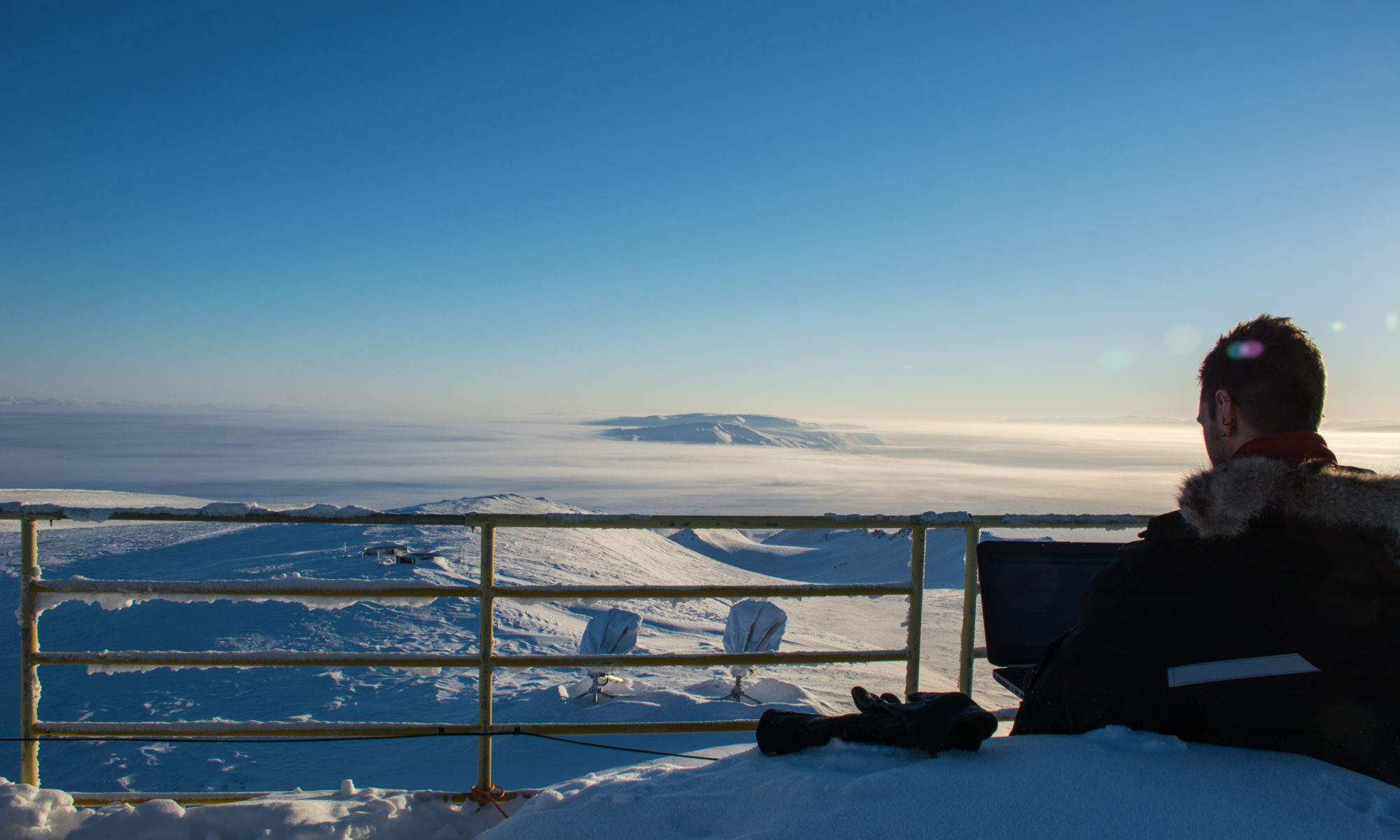
During the transition between Polar Night and the continuous daylight of summer (“Midnight Sun”), a team of Canadian scientists take measurements of the changing atmosphere above Eureka at the Polar Environment Atmospheric Research Laboratory (PEARL) using specialized instruments.

(I was part of that team until recently. Daily updates from the campaign are posted here.)

PEARL sunrise campaign
Installing atmospheric monitoring instruments on the roof of the PEARL Ridge Lab during the 2014 sunrise campaign.

The return of sunlight after a long absence generates significant changes in the atmosphere. Ozone depletion chemistry, for example, is acutely impacted. A former colleague of mine wrote a blog about it here.

I made a few plots to show how big the sunlight shift is in high Arctic, with a few other locations included for comparison. This change in light has profound impacts on the environment, animals and plants, and people.

In Toronto (43°N), the amount of sunlight in a day stretches from 9 hours in mid-winter to over 15 hours in mid-June.

Sunlight hours each day in Toronto

The size of the seasonal change in sunlight depends on latitude. If you go south from Toronto, there’s less change over the course of the year. In the Caribbean, for example, a hypothetical province called Saskatchewarm would have relatively stable sunlight throughout the year:

Sunlight hours each day in Turks and Caicos
Sunlight hours each day in the hypothetical “Saskatchewarm” in the Caribbean

Yellowknife, Northwest Territories (63°N) is much farther north than most Canadians venture. I recommend visiting it: there is fantastic art and culture to see. And it’s a good place to see Aurora Borealis. Since it’s 2000 km north of Toronto, it experiences a much larger swing in seasonal sunlight. It’s quite a big change: days in Yellowknife range from 5 hours in mid-winter to 20 hours mid-summer.

Sunlight hours each day in Yellowknife
Sunlight hours each day in Yellowknife (2000 km north of Toronto)

From the North/South point of view, Yellowknife is roughly equal distances between the southernmost and the northernmost parts of Canada. The Canadian Arctic is a vast region. Let’s head another 2000 km north to look at daylight in the extreme case of Eureka.

Arctic landscape - Ellesmere Island
Arctic landscape – Ellesmere Island

Eureka is a high Arctic research site at 80°N, on Ellesmere Island. The daylight hours plot is oddly shaped compared to southern sites. For most of the year, daylight doesn’t change day-to-day: it’s either totally dark or light.

Sunlight hours each day in Eureka

The transition between total darkness and never ending day takes only 2 months. This morning, the Eureka sunrise occurred at a rather convenient 10 am. It’ll set mid-afternoon. In a week, sunrise will occur more than an hour earlier, and sunset an hour later.

Rapid change in high Arctic sunlight shown as a plot of the number of sunlight hours per day over the course of the year for three sites at different representative and relatable locations: Toronto, Yellowknife, and Eureka
Rapid change in high Arctic sunlight

Sunrise at Eureka
Sunrise at Eureka, Nunavut from the road to PEARL

Why does this happen?

This happens because the Earth’s axis tilts the Polar Regions completely away from the Sun, and into complete darkness in winter, and tilts towards the Sun for part of the summer. During summer in the Arctic, the Sun moves in a circle across the sky once per day, never setting.

Figure 1 - Axial_tilt_vs_tropical_and_polar_circles
Over the course of the year in the Polar Regions, the Earth’s axial tilt creates Polar Night during winter and the Midnight Sun during summer.
Credit: https://en.wikipedia.org/wiki/Arctic_Circle#Midnight_sun_and_polar_night

If we combine the plots for all three sites, a couple of interesting dates pop out:

Sunlight at Eureka, Yellowknife, and Toronto

Here’s a fun trivia question to ask friends and family: on what day of the year do all places on the planet have the same length of a day?

The length of a day is equal everywhere on the planet two days a year.** These are the intersection points between the sunlight hours at Toronto, Yellowknife, and Eureka. If I added other cities, they would also intersect at those points. These special dates, March 20 and September 23, are when the Earth is facing the sun upright with no relative tilt. Day and night are both 12-hours long.  (Another trivia question could be on what day are day and night the same length.) They’re called the equinoxes.

Also noticeable on the plot is that the length of the day is maximum mid-summer (June 21) and minimum in winter (December 21). These dates are the solstices, when the tilt of the Earth is either fully towards or away from the Sun.

I hope this puts the changing daylight hours you experience in a new light.

Enjoy!

Sunset over Mississauga, viewed from downtown Toronto

Notes:

* Sunlit-hours, not the actual length of the day. Though in a small way, that is also happening. The length of the day is continuously getting longer due to the influence of the moon.

**  atmospheric refraction can slightly impact the equality of the daytime/nighttime on the day of the equinoxes.

Acknowledgements:

Thank you to the python community, which has developed and maintained the packages I use to make nice plots, i.e. matplotlib, numpy, pandas, and calculate the sunrise/sunset, i.e. ephem, pytz.