Baseball throw from the CN Tower — fun physics

The question

A Sportsnet reporter, Shawn McKenzie, recently asked a question that’s surprisingly tricky to answer:

could someone standing on the CN Tower throw a baseball all the way to third base at the SkyDome? 

From the CN Tower’s observation deck or EdgeWalk the baseball field looks close. Close enough to be a tempting target for a baseball throw…

Sportsnet turned the question into a great 5-minute video you can watch on YouTube:

(It’s also on Instagram here: https://www.instagram.com/p/DPRkyJ_EaRE/?igsh=Z2JuMXB5YzJhcWc1)

They included a short clip from what was a 30+ minute interview. We had a great conversation. For anyone interested, I thought I’d post more details about the physics of this scenario. 

(Personal aside: I worked as a host at the CN Tower during my undergrad degree. Hosts are the people who help visitors everywhere around the site – including the elevators rides. I enjoyed it. I recall looking down at the baseball field when the dome was open. However, it was also part of my job to ensure people didn’t throw objects from the lower observation deck, which used to be open to the air with a metal mesh…) 

Set up: the key information we need

To do this calculation, a few key facts need to be clarified: 

  • Characteristics of a baseball, 
  • Height, i.e., where the person is positioned at the CN Tower, 
  • Target distance, i.e., from the CN Tower to SkyDome’s third base, and
  • Speed of the throw, e.g., by a regular person and by a professional.

With this information we can estimate an answer.

A baseball’s physical characteristics are described by Major League Baseball official documentation here (section 3.01):

  • Mass: 5 to 5.25 ounces, which I converted to 145 grams
  • Circumference: 9 to 9.25 inches, which I converted to a radius of 3.7 cm
  • Shape: sphere, but not perfectly smooth. 

I used 365 m for the height of the person throwing the baseball. This is the height of the EdgeWalk, located on top of the observation section of the CN Tower. This seemed to be the most practical premise since it is where visitors can walk around outside. (I did the EdgeWalk years ago with a friend and I would do it again!)

263 meters was used as the distance of the target of third base. This is difficult to determine precisely and introduces a key uncertainty in answering the question. My first attempt at a rough estimate was to examine Google Maps and Google Earth. This suggested a distance between 200 m and 270 m. The dome is not open in most of the images but it’s worth noting that third base is the most distant of the bases from the CN Tower. Satellite images can be misleading due to viewing angles and distortions. A direct measurement is preferable. 

The segment producer measured the angle at the ground from third base (our target) to the EdgeWalk, which has a known height. From this, some trigonometry enables us to calculate the distance to be 263 m. This seems plausible and within the range suggested from the Google images. There are areas within the baseball diamond and stadium seats that would be closer to the CN Tower and easier to reach. Any distance greater than 200 m would likely be inside the SkyDome field and stands. As it turns out, that’s a much more achievable target.

Finally, we need to know how fast a person can throw a baseball. 

  • For a ‘regular person’, I used 90 km/h (25 m/s or 56 mph). This might be generous, but let’s think positively.
  • For a professional, I used 162 km/h (45 m/s), which is 100 mph. This seemed reasonable since the best pitch speed recorded in the current MLB is 170 km/h. This is roughly double the speed of a regular person. 

Also: throw angle 

The throw angle is also very important. For each throw speed, I used the angle that maximizes the horizontal distance. When throwing from a large height, the angle needs to be shallow (small) to maximize the horizontal distance.

Physics of the throw

The most important factors affecting the throw distance are gravity and air resistance.

Gravity is constant at the CN Tower: objects are accelerated downward at 9.81 m/s2

The density of air varies by height and in time. I used a typical value of 1.225 kg/m3

To illustrate the importance of these two factors in combination, imagine simply dropping the baseball from the EdgeWalk height of 365 m. 

Without considering air resistance, the ball would take about 8.5 seconds to reach the ground. However, once we add air resistance, the ball would take about 12 seconds. 

For comparison, dropping the ball from the same height on Mars, which has one third the gravity of Earth, would take 14 seconds to reach the ground without air resistance and 20 seconds with (Earth’s) air resistance.

Results: ignoring air resistance

A first year undergraduate physics student should be able to analyze the motion of the baseball and calculate the range without air resistance. This is not realistic. However, let’s start there.

This result shows that a professional can throw a baseball to third base. Perhaps even reaching the opposite side of the SkyDome stadium! A regular person could throw the baseball onto the field, but falls short of third base.

Now let’s consider the effect of air resistance. It may be more dramatic than some expect.

Results: with air resistance

There are a few challenges to doing this calculation with air resistance. 

The drag force created by the air is (very) speed dependent. As a result, you can’t do one calculation. Instead, I had (python language) code perform a calculation every 0.01 seconds of flight time to account for the changing speed and drag.

There is another decision: what model of drag should be used? I used the equation found in first year undergraduate physics textbooks:

For this situation, it is appropriate.

In the equation:

  • A is the area of the object in the direction of motion, a circle with a 3.7 cm radius
  • ρ is the density of the fluid (I’ve taken that to be 1.225 kg/m3)
  • v is the velocity of the object (baseball)
  • C is the drag coefficient. I used 0.38.

A typical C value for smooth spheres is 0.5. However, a baseball’s surface is rough and (significantly) it has raised stitching. The physics literature has measured a range of results for this value, e.g., Kensrud & Smith (2010), especially Figure 7, and Kagan & Nathan (2014). I used 0.38 as a conservative estimate.

Here are the results using those values:

Neither the regular person or the professional was able to reach the target. The professional might have been able to throw the baseball into the SkyDome, e.g., somewhere in the stands nearest to the CN Tower. That’s still impressive!

A logical question to consider is:

What throw speed IS necessary to reach third base, at a distance of 263 m?

Answer:

  • Without air resistance: 104 km/h (65 mph)
  • With air resistance: 300 km/h (186 mph)

It’s unrealistic for someone to throw a baseball at 300 km/h. These results suggest that someone might be able to throw a baseball from the CN Tower EdgeWalk inside the SkyDome. However, it’s very unlikely they could reach third base. 

Other solutions?

If 300 km/h seems impossible for a person, what else could we do?

Get higher

Additional height doesn’t help the horizontal range much. Even if you somehow stood on the very tip of the CN Tower spire (not recommended, especially in stormy weather), a height of 553 m doesn’t extend your throw by more than several meters. Air resistance and gravity are too much of a constraint. 

Spin

There is some range to be gained by ensuring the throw includes backspin. The magnus force created by spin can create a form of lift. Experimental analysis of backspin on baseball flights show that it is a difficult topic. Spin can help extend horizontal range (e.g., Nathan, 2008Alaways & Hubbard, 2010Kensrud & Smith, 2010). However, this also increases drag. The scale of the benefit would not be enough to make up the distance shortfall we saw in the earlier calculations.  

Moving to a different location

Since drag from air resistance is proportional to air density, we could move to a higher altitude, where the air density is lower. Moving the CN Tower is not realistic, but we could think about it for fun. 

The major city at the highest elevation I found was Lhasa, Tibet. It is at an altitude of 3.65 km and the air density is 0.83 kg/m3. However, it seems this change isn’t enough to meet our goal.  

What about the highest elevation in Canada?

Mount Logan in Yukon Territory has a height of 6 km. At this altitude, half of the atmosphere’s mass is beneath you! The air density is 0.6 kg/m3

Success!

The professional can throw the baseball and hit the target.

All we have to do is move the CN Tower and SkyDome to the peak of Mt. Logan. 

Change gravity

What if we could change gravity? e.g., to match the strength of gravity at the surface of the moon or on Mars?

If we magically changed to Martian gravity (3.7 m/s2), a regular person still falls short (173 m); however, the professional gets close enough that I think we can claim potential success: 247 m.

If we push further and consider Lunar gravity (1.625 m/s2), a regular person still falls short but likely reaches the inside of the stadium. Maybe the baseball even gets onto the field. 

Actual solution: wind

In the real world, a lucky gust of wind is the only way I think a professional pitcher can throw a baseball from the CN Tower EdgeWalk and it reaches third base in the SkyDome. The effect of wind is not trivial to calculate, and it varies in time and altitude. However a strong and sustained gust of wind could give the extra distance needed. 

But this situation raises a philosophical question: 

if the wind does much of the work, can we really say a person threw the ball to third base?

How far do you think you could throw a baseball from the CN Tower?

Further reading

There have been quite a few people interested in the physics of sports. Published papers about baseballs go back at least several decades. Here are a few highlights for anyone interested in reading physics literature about the details.

D. Kagan and A. M. Nathan, “Simplified models for the drag coefficient of a pitched baseball,” Phys. Teach. 52, 278–280 (2014). https://doi.org/10.1119/1.4872406

A. M. Nathan, “The effect of spin on the flight of a baseball,” Am. J. Phys. 76, 119–124 (2008). https://doi.org/10.1119/1.2805242

A. M. Nathan, “The physics of baseball: What’s the deal with drag?” Phys. Teach. 53, 332–335 (2015). https://doi.org/10.1119/1.4928349

L. W. Alaways and M. Hubbard, “Experimental determination of baseball spin and lift,” J. Sports Sci. 19, 349–358 (2001). https://doi.org/10.1080/02640410152006126

J. R. Kensrud and L. V. Smith, “In situ drag measurements of sports balls,” Procedia Eng. 2, 2437–2442 (2010). https://doi.org/10.1016/j.proeng.2010.04.012

J. R. Kensrud and L. V. Smith, “Drag and lift measurements of solid sports balls in still air,” Proc. Inst. Mech. Eng. Part P: J. Sports Eng. Technol. 232, 255–263 (2017). https://doi.org/10.1177/1754337117740749

National Flag of Canada Day 2025

On this 60th anniversary of the Canada Flag, at a time when our neighbour to the south unexpectedly threatens our sovereignty, I share a memento I have kept from my grad school fieldwork: a flag that flew at PEARL, the high Arctic atmospheric observatory located on Ellesmere Island at 80˚N.

Canada Flag, worn at right edge from Arctic winds over time.
This flag was taken down at PEARL on February 28, 2012 (original campaign website photos) because it had become battered by the harsh Arctic environment.

I’ve had this flag since 2012 – my first field campaign at PEARL, and my first time in the Canadian Arctic. It is a reminder of my time at PEARL and enthusiasm for its unique research. But my memories of that trip involve more than science. Then, as now, a larger political context loomed over us, casting an unsettling shadow

The battered state of the flag seemed symbolic of the larger Canadian science mood in February 2012. Canadian science, too, was weathering a storm.

Canadian atmospheric researcher passes in front of PEARL's wind-damaged Canada Flag in February, 2012
Canadian atmospheric researcher passes in front of PEARL’s Canada Flag in February, 2012

About a week after we arrived at the remote research lab, began our measurements, and hit our stride, we were informed that its funding was cut. It wouldn’t just be Canadian atmospheric research; there were widespread cuts to science support. As an Ottawa-born and proud Canadian, I embrace winter weather. But this political chill struck me deeply and motivated a new engagement in science advocacy that continues to this day.

(A fuller retelling of my first Arctic field campaign and funding loss story was posted here.)

What did we do at PEARL in 2012, when faced with existential uncertainty? 

Proudly raise a new flag. 

It’s still there.

New flag raised at PEARL, February 28, 2012. From left to right: Pierre Fogal, Dan Weaver, Debora Griffin. Photo by Volodya Savastiouk.

What should we do in the face of this new uncertainty and national challenge?

Remind ourselves why we’re here, what we’re trying to achieve, and fight for it. 

One step is easy and meaningful: proudly raise our flag.

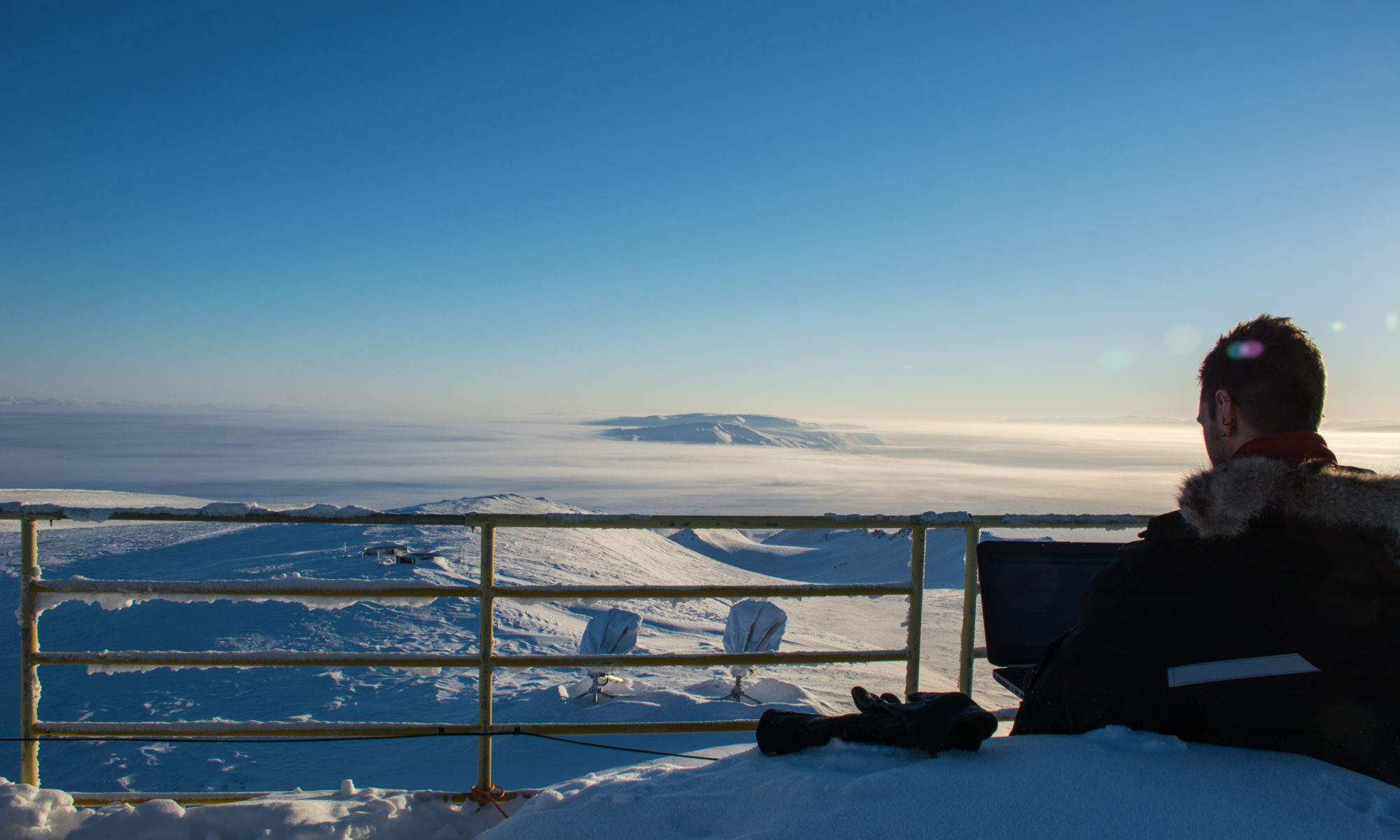
Photo from the PEARL roof during one of my last Arctic fieldwork campaigns.

Runaway Canadian Science Balloon: MANTRA 1998

25 years ago, in late August 1998, something interesting happened in Canadian atmospheric science:

A large Canadian scientific stratospheric balloon was launched from Saskatchewan on August 24, 1998. It was intended to have a flight lasting about 24 hours and stay relatively near its launch site. Instead, it went on an unexpected adventure across an ocean and into several countries’ airspaces. Fighter jets were tasked with taking it down. World news organizations covered the updates. 

This is the MANTRA 1998 story. 

What is a stratospheric balloon?

It’s a very large balloon, typically filled with Helium, that carries a scientific payload (instruments and support systems) weighing up to ~a tonne (1000 kg) into the stratosphere (15 to ~50 km altitude).

They can be as tall as the CN Tower observation deck!

Credit: Canadian Space Agency, About Stratospheric Balloons

Stratospheric balloons like MANTRA are much larger & complex than common weather balloons, which also are typically Helium filled and carry instruments into the stratosphere. But those payloads are very small and light: ~250 g. That makes MANTRA’s scientific sensor payload (~300 kg) about 1200 times larger. Some sensor payloads are even larger. 

Eureka Weather Station balloon launch preparations.

MANTRA (Middle Atmosphere Nitrogen TRend Assessment)

MANTRA was 150 meters high or about the size of a 25-story building when at stratospheric altitudes.

Photo showing MANTRA98 being prepared for launch, overnight August 23/24, 1998.

The MANTRA balloon included a variety of instruments designed to measure ozone chemistry-related atmospheric gases. There were also systems for power and control of the balloon. Its gondola was 2 m × 2 m × 2 m in size, constructed using a light aluminum frame. The total payload weighed 630 kg. 

Schematic of MANTRA gondola from Strong et al. 2015.
Schematic of MANTRA gondola from Strong et al. 2005.

More specifically, MANTRA instruments sought to acquire: 

  • Vertical profiles of: NO2, HNO3, HCl, CFC-11, CFC-12, N2O, CH4, temperature, and aerosol backscatter from balloon instruments. 
  • Total columns of: O3, NO2, SO2, aerosol optical depth by ground-based spectrometers.

Next: The Launch and Flight

Seasonally Shifting Sunlight

Two major aspects of seasonal change are weather and the “length of the day” — i.e.,  the number of sunlight hours.

The magnitude of this change depends on latitude. Near the equator, the amount of sunlight stays relatively constant. In mid-latitudes there’s quite a noticeable change in the length of daytime. In Toronto, for example, the amount of sunlight in a day stretches from 9 hours in the middle of winter to over 15 hours in the middle of summer. In the polar regions the change is even more dramatic. There are times when the sun never sets (“midnight sun”) and times when the sun never rises (“polar night”). The seasonal change in sunlight has profound impacts on the environment, animals and plants, and people. 

I wrote an earlier post about sunlight changing over the seasons, motivated by my time doing fieldwork in the Canadian High Arctic. In this post, I wanted to look at the same topic more generally and create an interactive plot for people to explore.

Joseph Mendonca and I watch the sun rise late morning in Eureka, Nunavut (photo credit: Paul Loewen)
Joseph Mendonca and I watch the sun rise late morning on Feb. 25, 2013 in Eureka, Nunavut (photo credit: Paul Loewen)

This interactive figure illustrates the number of sunlight hours there are at a various Canadian cities and locations.

Sunlight hours

You can select a location by clicking on the entries in the legend.
There are tools in the top-left of the figure to let you zoom in and explore the data.

Why does this happen?

This happens because the Earth’s axis tilts the Polar Regions completely away from the Sun, and into complete darkness in winter, and tilts towards the Sun for part of the summer. During summer in the Arctic, the Sun moves in a circle across the sky once per day, never setting.

Figure 1 - Axial_tilt_vs_tropical_and_polar_circles
Over the course of the year in the Polar Regions, the Earth’s axial tilt creates Polar Night during winter and the Midnight Sun during summer.
Credit: https://en.wikipedia.org/wiki/Arctic_Circle#Midnight_sun_and_polar_night

Here’s a fun trivia question to ask friends and family: on what day of the year do all places on the planet have the same length of a day? The length of a day is equal everywhere on the planet two days a year.** These days are called the equinoxes. You can see these days by plotting multiple sites and looking where they intersect. I’ve also added an option on the plot to show them as lines on the plot.

Also noticeable on the plot is that the length of the day is maximum mid-summer and minimum in winter. These dates are the solstices, when the tilt of the Earth is either fully towards or away from the Sun.

I hope this puts the changing daylight hours you experience in a new light.

Enjoy!

Sunset over Mississauga, viewed from downtown Toronto

Notes:

* Though in a small way, changes to the actual length of a day is also happening. The length of the day is continuously getting longer due to the influence of the moon.

**  atmospheric refraction can slightly impact the equality of the daytime/nighttime on the day of the equinoxes.

Acknowledgements:

Thank you to the python community, which has developed and maintained the packages I use to make nice plots, i.e. bokeh, numpy, pandas, ephem, and pytz.

Finding the best Canadian-made N95 masks

Where to buy the best masks has come up a couple times with friends, who saw me post pictures of myself at work with an N95 mask. This post shares the sources I’ve found.

I’m a physicist, not a physician. This post is not medical advice.

(TL;DR: I like these masks. Also these. These are really good but they’re pricey. They are all Canadian-made N95-equivalent masks.)

I live in Toronto, which isn’t have a good time with COVID. Hopefully the pandemic will be over soon. At the moment, I am not yet vaccinated and still have a few things to do indoors around other people — medical appointments, occasional in-person work stuff — so I wanted to get a high quality mask. I don’t own a car, so going from A to B is either transit or Uber. I also want to be ready with a good source of masks in case the pandemic isn’t quite over but I’m teaching on campus this fall.

Dan in his UTSC office (May 3, 2021)
In my U of T Scarborough office wearing a Canadian-Made N95 (May 3, 2021). Please excuse the pandemic hair…

I started a year ago with a simple fabric mask. Then I got a box of surgical masks. Those work well (e.g., Bartoszko et al., 2020), are fairly comfortable, and generally come at a reasonable cost. The really cheap ones can be kinda awful. But the cost of good quality ones isn’t too bad (~$0.35/each).

CBC Marketplace visited a U of Toronto lab that did some comparisons of mask types. Surgical masks came out on top (CBC article here). The type of fabric mask U of T provided to all its faculty, staff, and students? It was at the bottom of the rankings. So I’m not trusting my workplace-provided mask. Except maybe on top of a good mask, for the sake of fashion…

Dan cleans the UTSC Pandora window (March 10, 2021). Photo Credit: Don Campbell, U of T Scarborough
Cleaning the window of an atmospheric measurement instrument (Pandora) at UTSC (March 10, 2021). Photo Credit: Don Campbell, U of T Scarborough.

I found an unlikely source of Korean KF-94s, which fit really well because of their different design. It was much easier to wear glasses/sunglasses with them. This prompted me to start looking beyond surgical masks.

What I want:

  • greatest protection to the user — ideally N95 mask
  • clear provenance — ideally made in Canada with transparent standards and test results
  • good fit and comfortable — I had to try a few to figure this out

Why an N-95 mask?

N95 masks work better than other masks. In part this is because they have a layer with an electrostatic charge. Some European countries started requiring citizens to wear N95-level masks back in January. The YouTube channel Minute Physics did a really great short video about N95 masks (here).

(For the more technically inclined, here’s a science journal article by Bandi (2020) that describes how to manufacture N95-type materials for masks.)

There are lots of masks online that come from China. Or that aren’t labelled with a clear company/origin. Or the company and product info can’t be found online. For example, most masks from Walmart.ca and Amazon. Also, 72hours.ca has KN95s and “Made-in-Canada” N95s but I can’t seem to find any info about the companies. That might be ok? It’s hard to know. I’d prefer to buy masks from a known manufacturer that meet high standards and post independent lab test results.

Chinese (KN95) and other ‘N95 equivalent’ masks sometimes fall significantly short of N95 standards (e.g., ECRI report, CBC tests). I did buy a few KN95s because that’s what I could initially find. It would be preferable to buy from a Canadian company that is transparent about its standards and testing.

Here are high quality Canadian N95 masks I’ve found:

Eclipse N95 Masks

Eclipse Innovations is a company that manufactures N95 masks in Canada. You can read about them and their mask standards on their website here.

The nose bridge forms a really good fit and has comfortable secure padding. The straps go around your head to keep it snug. They might feel too hardcore for casual use. But if you want to go all-in, I think this is a solid choice.

Eclipse N95 masks. Note the padded mouldable nose part in the third panel.

The name of the distributor company they recommend, HotZone, is a bit “on the nose”. But I had a good order experience and would recommend them:

<https://hotzonetraining.com/personal-protective-equipment/>

The box contained 25 masks and each mask was individually sealed. That’s a nice feature.

(Supply + Protect is another Canadian website that carries the Canadian-made Eclipse N95 masks as well as surgical masks. But I haven’t used them.)

The downside is that the Eclipse N95 masks are expensive.

HotZone also sells surgical masks that look good and are much lower cost.

Dent-X & First Nations Procurement Inc. FN95s

This is my current favourite. They have a different shape from the other N95s I’ve had/seen. I find them the most comfortable of all the masks. I sometimes use a clip that came with my KF94s to connect the ear loops behind my head. This makes the mask fit snug.

Company website here, with mask details.

Dent-X & FNPI FN95 masks. Note the different shape. I find it the most comfortable.

I bought a pack from Canada Strong Masks (they also sell cotton masks):

<https://canadastrongmasks.ca/collections/canada-strong-collection/products/canada-strong-cn95-respirator-mask-made-in-canada-canadian-n95>

They’re lower cost than the Eclipse masks. Though they still cost more than surgical masks.

It’s interesting to note that these purchases support the Canadian Cancer Society. In addition, the masks are made by a partnership between Dent-X and First Nations Procurement Inc. (FNPI), which is a Certified Aboriginal Business with manufacturing facilities in Northern Ontario reserves (story). Sounds great all around.

Vitacore CAN95 masks

These have the best branding (“CAN95” with a nice maple leaf logo). The company seems good and were recently featured on CBC (article and video). I find them comfortable, though not as good as the other two above. They sell them in the ear-loop version or the headband style (like the Eclipse model).

<https://www.vitacore.ca/can95-respirator>

They also sell surgical masks and CAN99 masks.

Vitacore N95 masks. Nice Canadian branding.

Single use or re-use?

N95s get pricey if you wear them everyday. I don’t. I use one or two a week, when I’ll be around people indoors without distancing at times. I consider that cost worth it for the peace of mind that I’m doing everything I can do to stay safe (and because I can afford to). If I’m doing something where there is minimal exposure potential, e.g., a brief trip inside a cafe to pick up a coffee, I’ll wear a surgical mask or the more comfortable Dent-X N95, and I might hang it somewhere in isolation for a week before re-using it. It’s worth noting: don’t wash an N95 with soap and water since this diminishes the charge layer (Juang & Tsai, 2020).

If you have a good source of masks or tips, comment below!

The opportunity created by not attending the global climate strike

A couple months ago, on Sept. 27, there was a global climate strike.

I didn’t attend.

I had to teach classes, despite many colleagues (including me) signing an open letter to U of T asking classes to be cancelled (Varsity article). It turned out to be a valuable opportunity.

U of T did suggest that instructors avoid penalizing students for attending the climate strike. I announced that there would be no penalty for not attending that day. About half the class didn’t show up, hopefully deciding to contribute their voice to the event.

I guessed that the students who *did* come to class instead of attending the climate strike were more likely to be skeptical about climate science and the significance of the issue. At the start of lecture, I opened the floor to any questions about climate science.

Not being at the event put me in the room with one of the most important audiences: people who are *not* already persuaded that climate science is robust and that action is needed. It was a good opportunity to engage with them.

There were definitely some skeptical of the science and humanity’s contribution to climate change. Students were quiet at first, but after a couple of people asked questions, e.g., the evidence of actual warming, more questions started to flow.

I was told some didn’t feel comfortable asking initially because they expect to be scolded for having the “wrong” opinion. Once it became clear that I wasn’t judging them and having a genuine Q&A, the session became interesting and more students got involved. We used the hour.

I’m mentioning this now at the end of term because this started an ongoing conversation with a few students, who came to me after lectures and at office hours throughout the term asking more questions about climate science.

I didn’t try to persuade them to support a specific policy or accept a specific idea. But I did push them to think critically about the skeptical claims and to talk to people in the field when they have questions. There are many that generously make themselves available.

I was initially disappointed I couldn’t be at the climate strike. But in the end, I’m happy with how not attending turned out because of the engagement it created in some skeptical students.

Photos featured by Blackwood Gallery

Pair of Arctic researchers walking

Several of my photos have been featured in the Blackwood Gallery’s newly-published broadsheet, Society for the Diffusion of Useful Knowledge (SDUK) Volume 4: Grafting. A PDF copy of the full publication is online here.

The vision of the SDUK project is:

“To productively collide with the present crisis, ideas cannot be constrained by disciplines. An ecology of knowledge based on the relationship and antagonism of “useful” ideas will be composed and circulated through THE SOCIETY FOR THE DIFFUSION OF USEFUL KNOWLEDGE (SDUK). The name of this innovative platform is borrowed from a non-profit society founded in London in 1826, focused on…  spreading important world knowledge to anyone seeking to self-educate…”

(See here for full details.)

Here’s my photo essay piece:

(You’ll want to use the controls on the bottom to go full-screen and/or zoom in: it’s meant to be printed in large format)

Blackwood Gallery Broadsheet SDUK Vol04 Shoring (Dan Weaver PEARL)


There are some interesting pieces in the issue. My favourite is by Skye Moret, who presents the colour pallet of Antarctica in a visually stunning and fascinating way. A version of her piece is also on her website here.

The printed publication has been distributed at libraries, bookstores and communities centres in the GTHA and across Canada.

Big news: a new job

Big news: a new job

Next week I start a new job:

Assistant Professor (Teaching Stream) at the Department of Physics and Environmental Sciences (DPES), University of Toronto Scarborough.

This job is an amazing fit for me.

Here’s a few reasons why:

Academia

I’ve wanted a job in science.  But I don’t only want to do science. I want a job that enables me to teach and do public outreach in a meaningful way. I spent a great deal of time and effort over the last decade working in education through NGOs, companies, and at U of T in a variety of roles. I also have a teaching degree. This position is teaching-focused, which is great, in addition to allowing me to continue to do research.

As an academic, I’ll also be able to continue doing science advocacy. Many of my former colleagues have gone to work for government science departments, such as Environment and Climate Change Canada (ECCC). It’s a nice career path, with stability and important work. But public servants are limited in their ability to criticize government policy, which I’ll be free to do. Given the continuing struggle to keep facilities like PEARL funded, the overall lack of ambition on many science topics, this privilege will be put to good use.

Dan discussing science engagement at U of T's Rawtalk Live event
Dan discussing science engagement at U of T’s Rawtalk Live event (May 30, 2018).

Downtown U of T vs. Scarborough

I’ve spent the last 15 years living and working near downtown. The U of T downtown campus (UTSG) location has clear advantages. There’s an appealing energy and convenience to being close to the core of Canada’s largest city.

Royal Ontario Museum

But I wanted a change. I grew up essentially across the street from the Ottawa Greenbelt, and spent the warmer months of the year camping and cottaging in the surrounding rural areas of Ontario. Downtown Toronto doesn’t have enough greenspace. I spent the last several years living next to High Park. It was a great way to find balance. The U of T Scarborough campus has a strong environmental focus and is adjacent to a large forest, which is immensely appealing.

Leaf in High Park on a rainy day

I’ve moved to the east end of Toronto (Upper Beaches), and aim to do part of my commute by bike in the warm months, since there are trails that run from UTSC to GO Transit stations. That’ll be much nicer than biking along College St. to downtown U of T!

UTSC location (from Google Maps)
UTSC location (from Google Maps). Lake Ontario is at the bottom-right. Red marker shows where I’ll be working.

I have to admit one big downside: public transit in Scarborough is badly inadequate. I’m now enthusiastically cheering for Toronto (& other transit-funding levels of government) to build the Eglinton LRT line out to UTSC.

Interdisciplinary department

I’m not joining a physics department. DPES is a mix of physics, chemistry, astronomy, and environmental sciences. That’s also a quick way to summarize my academic background. I did my B.Sc. in astronomy & astrophysics, my M.Sc. in physics, and my Ph.D. in physics with a collaborative program in environmental studies. I’ve also spent considerable time engaged with environmental policy topics. I’m looking forward to interacting with colleagues across these fields. Ideally, I’d like to build a course or two that crosses disciplinary boundaries.

Experimental physics and environmental issues

My specific areas of focus will be exactly my areas of core interest: experimental physics and environmental connections to physics. One of the first large tasks I’m undertaking is a complete re-building of the undergraduate physics laboratory courses. I’m thrilled – this is exactly the type of project I’m keen to do. I’ll also be creating a course on atmospheric physics. Other ideas are floating around, too, but I should leave something for later blog posts.

Dan adjusting beamsplitter door of the PEARL 125HR spectrometer
Dan adjusting beamsplitter door of the PEARL 125HR spectrometer during the 2015 ACE/OSIRIS validation campaign.

Summary

I expect to be (very!) busy for the next few months (years?) as I get started with this exciting new chapter in life. There are challenges ahead. But I’m proceeding with enthusiasm. I’m joining a great institution and department. I’m still close enough to collaborate with my friends downtown at U of T and at ECCC. And if I need the excitement of downtown Toronto, there’s always the weekends.


Finally done my doctorate

Finally done my doctorate

It has been a long road, but I have at last reached a significant milestone:

I’ve finished my Ph.D.

Working towards this goal at U of T’s Physics Dept. has been a difficult but rewarding experience. I’m thankful to many people. My supervisor, Prof. Kim Strong, especially, as well as my fieldwork teammates. Graduate school is an opportunity to grow and change. I’ve tried to make the most of it. I thought I’d reflect on a few highlights.

Fieldwork at PEARL

Travelling to the frozen northern edge of Canada each winter to maintain and operate instruments at the end of Polar Night was an incredible experience. (Part one of my articles about the campaigns for U of T News; a Virtual Tour of PEARL slideshow.)

Dan looks through boxes of equipment at the start of a PEARL campaign.

Spending a month at a time in an extremely remote and cold environment isn’t for everyone. But it was a great fit for me. I have developed a great affection for Canada’s Arctic.

Volodya and Dan carry Brewer spectrophotometer to the roof of the PEARL Ridge Lab (photo credit: Pierre Fogal)

In addition to the opportunity to contribute to important research – the measurements we took during campaigns was used to study the Canadian Arctic atmosphere, but also contributed to international networks studying our changing global atmosphere and validate satellite measurements – it was also an opportunity to develop and apply my interest in photography. I am delighted that the photos I took while at PEARL have been used in national newspapers, on the covers of science journals, and more. It was great fun.

Dan Weaver taking photos on Ellesmere Island, in the Canadian Arctic (Photo Credit: Paul Loewen)

(More photo highlights can be found here.)

Science advocacy and marches

During my first trip to PEARL in 2012, funding for the lab was ended as part of systematic cuts to Canadian science. My longstanding interest in politics primed me to take action. I wrote letters to politicians, talked to the media, contributed to science advocacy organizations, and helped to organize science marches in Toronto.

Marching down major streets of Canada’s largest city was an exhilarating experience. Most of all, I met incredible people also advocating for science in Canada.

Dan kicks off the Toronto March for Science (credit: Paul Martin)
Dan kicks off the 2017 Toronto March for Science (photo credit: Paul Martin)

Sharing PEARL’s Arctic research with the public

I believe PEARL’s work is important. But until I was on Kim’s research team, I had never heard of it. Nor was I aware of Canada’s incredibly successful science satellite, the Atmospheric Chemistry Experiment (ACE). I tried to raise the profile of these research projects. I can’t claim all Canadians know about PEARL and ACE. But I’d like to think that my school visits in Ontario and Nunavut, dozen public talks, social media channels, and other efforts have broadened recognition of their importance.

Social media can be a fun way to highlight fieldwork. Even if it's exchanging jokes about how Eureka resembles an ice planet in a galaxy far, far away...
Social media can be a fun way to highlight fieldwork. Even if it’s exchanging jokes about how Eureka resembles an ice planet in a galaxy far, far away…

Science is largely funded by the public. I believe scientists should actively seek to connect with the public.

Dan giving a Story Collider talk about PEARL fieldwork
Dan giving a Story Collider talk about PEARL fieldwork (photo credit: Ally Chadwick, @JustMyFreckles)

Travel to conferences

I travelled to two major international conferences during grad school: the 2014 American Geophysical Union (AGU) meeting in San Francisco and the 2018 European Geophysical Union (EGU) meeting in Vienna. It was gratifying to present my research. Connecting with researchers from around the world was eye-opening and inspiring.

Vienna Opera House
Vienna Opera House (more Vienna photos here)

A keynote at AGU by former-US astronaut and then-NOAA chief Kathryn Sullivan still occasionally surfaces in my head. She discussed how she saw NOAA as America’s ‘environmental intelligence’ organization, which I thought was an interesting way to frame its work. For some audiences, I imagine it is more effective than focusing on the inherent value of environmental protection and science – even though I find the latter persuasive.

Dan discusses satellite validation research during poster session
Dan discusses PEARL water vapour measurement research during poster session

In addition to conferences, I attended meetings of an international network PEARL measurements contribute to, giving me the chance to visit Switzerland, Japan, and Korea. I spent two weeks exploring Switzerland and Japan after the meetings with a friend of mine, Nathan. We had a great time on both trips. Both times I was left with the clear realization that Canada has really poor rail system… (I write this while on a train between Toronto and Ottawa that is an hour late…)

Japanese Shinkansen train
Japanese Shinkansen train that travels at 300 km/hr. VIA Rail can’t even dream this ambitious!

Starting an environmental organization on campus

I greatly enjoyed the interdisciplinary conversations I had with people at the U of T School of the Environment, where I took a collaborative program. I created an organization to foster a sense of community amongst the grad students there, the Graduate Environmental Students’ Association. One highlight for me was inviting Jennifer Baichwal to do a Q&A at a U of T screening of Watermark, a documentary she produced that explored society’s connections with water in collaboration renown Canadian photographer Edward Burtynsky. We held a screening of Watermark and had a Q&A with her. The execution of that event happened after I left GESA; it was nice to be able to sit back and enjoy it once the day arrived.

Dan moderating a panel discussion about neonicotinoids for a GESA event at U of T

Teaching

Before grad school and my research internship at the Toronto Atmospheric Observatory (I have an interest in rooftop views), I took a degree in education and became an Ontario-certified physics and civics teacher. When I started grad school, I was keen to dive into duties as a Teaching Assistant. The department recognized my interest and qualifications and gave me opportunities to apply those skills as a Senior TA. I trained new graduate students in teaching and managed a large team of TAs for a first-year physics course.

Dan discussing science engagement at U of T's Rawtalk Live event
Dan discussing science engagement at U of T’s Rawtalk Live event

Even more interesting, I co-created a pilot course connecting science students with entrepreneurship on campus. I worked with a Rotman School Prof. to give top U of T science undergrads a chance at applying their analytical skills on the real-world challenges faced by U of T startup companies. It was an good experience for everyone involved and it was a reminder to me that most students don’t go into academia after they graduate. I continue to believe we should do more to connect university undergraduate students with experiences and information related to non-academic career paths.

What’s next?

The journey was fulfilling, frustrating, and fun. I’d love to travel to PEARL one last time, but that’s unlikely. It’s time for something new.

I’m aiming to keep to keep engaged with the themes that defined my life over the last decade: physics and education, science and society, and interdisciplinary environmental issues. I’d like to fit in some music and outdoors time, too.

But where exactly I’m headed will be my next post. Onwards to 2019!

Dan watching Arctic wolves in the distance


Vienna 2018

Cars leave streaks of light along the road curves around the downtown Vienna Opera House

I was in Vienna mid-April to attend a science conference, the European Geophysical Union meeting. I had the chance to explore the city a bit. The fantastic transit system made it easy to visit the sights around town.

Here’s a few highlights of my photos: